Selasa, 26 Januari 2016

10 Bali Hidden Beaches


10 Bali Hidden Beaches

Hidden Beaches Of Bali

Here’s a fact: Most people go to Bali for its fine collection of beaches. There is one for everyone, whether it be the long stretches of soft white sand on the south, the combinations of exotic black volcanic on its west, and the tranquil fishing coasts in the less-explored east. You might have done Kuta, Sanur and Nusa Dua and would be forgiven for thinking that these are all that make up Bali’s wealth of shorelines. So how about those not for everyone? There are some under cliffs, some beyond the mainland, and others away from the beaten path.

With a slight penchant for adventure, a set of wheels and our maps to guide you, you can discover some of the island’s coastal gems that will have you coming back for more. Here we share with you our roundup of Bali’s 10 ‘hidden’ beaches that we have discovered so far. With a bit of exploration, you are in for some rewards.

1. Perasi Beach Karangasem, East Bali 

Perasi Beach, referred to by various nicknames such as Pasir Putih or ‘White Sand Beach’, ‘Virgin Beach’ and simply, ‘Hidden Beach’, is a secluded stretch of coast between two hills that lies between the villages of Bugbug and namesake Perasi, both in the Karangasem regency - approximately 4.5km east of Candidasa. Boasting parasols, sun loungers and various local seafood restaurants, this hidden gem can be an added adventure to your trips to the island’s east shores. 

How to get there: From Candidasa, continue on to the Jalan Raya Candidasa-Bugbug main road to Perasi. A dirt road opposite the village’s Pura Bale Agung temple leads to the beach.


2. Balangan Pecatu, Jimbaran 

A favourite surf spot, Balangan is on the northern side of the cliff that forms the signature hole 15 of the New Kuta Golf course. The name ‘Balangan’ itself was thought to apply to the whole coastline including Dreamland, before surfers nicknamed the specific shore area south of the cliff. Several beach shacks serve simple local ‘surfer meals’, cold refreshments and beer. Accessing Balangan is easy, compared to other beaches along the Bukit peninsula’s shoreline, with only a dozen steps down from the limestone hill.

How to get there: Head up the hill to Pecatu. Various signs at the main intersection bear directions to Balangan.


3. Green Bowl Ungasan, South Bali 

Despite the cease in operations of the Bali Cliff Resort, this hidden gem on the southern coast of Bali beside the hotel site continues to appeal to lovers of quiet and exotic shores. This beach deserves to be in the ‘hidden’ category due to its access – a descent of hundreds of concrete steps down the cliff face. At the base are several bat caves. There are variations in the origin of the name, one inspired by the view of green seaweed and corals exposed at low tide, another owing from the name of the company slated to develop a resort there. Getting down is easy. Back up is a challenge, but a scenic bird’s eye view keeps you going along the way.

How to get there: Follow down the road known as Jalan Bali Cliff, and go around the derelict hotel site to a small parking space before the steps down.


4. Amed Karangasem, East Bali 

Amed spans seven different seaside villages: Amed, Jemeluk, Bunutan, Lipah, Selang, Banyuning and Aas. All are fishing villages, hence the classic scene of traditional jukung outriggers lining the coast. Famous as a dive spot, the quiet shores with its dramatic sunrises are a not-to-miss sight if you’re staying here. Among the overland highlights that you can find on your way back from Amed is traditional salt farming in the area of Purwakerti. A two-and-a-half hour’s journey back to the south will offer you more viewpoints that are scenic and other attractions in the Karangasem and Klungkung regencies, such as the Tirta Gangga water gardens and the Goa Lawah Temple.

How to get there: The long drive east is straightforward, passing the Klungkung and Karangasem entry points. Various road signs provide you a fail-safe journey.


5. Dream BeachOffshore, Southeast Bali 

Nusa Lembongan it self is a destination for the adventurous, a 27km boat ride from Bali mainland’s Benoa Harbour or Sanur coast. And the islet is dotted with several sandy bays that add further seclusion to your escape. Dream Beach is located on the southern shores of Lembongan and features fine white sand, behind a row of palms and thorny shrubs. You’ll find a set of bungalows of the same name here, along with Pandan Cafe.

How to get there: Head southward to the villages from the main eastern resort-filled bay and look for the signposts for ‘Devil’s Tear’, ‘Cafe Pandan’ and ‘Dream Beach Bungalows’.


6. Karma Beach Ungasan, South Bali 

Formerly known as Nammos Beach after Karma Kandara’s Beach Club, this private beach is accessed by a funicular ride down a sheer cliff where a stretch of clean white sand and blue sea awaits. Karma Beach features a laid-back tropical beach setting and five-star services for guests who wish to sip signature cocktails and indulge in a Mediterranean-inspired menu of selections prepared from a kitchen housed under a raised bamboo structure. You’ll have to pay an entrance fee here that is set against the price of food and drinks.

How to get there: Various road signs up in Ungasan lead you to Karma Kandara Resort on Jalan Villa Kandara.


7. Finn's BeachUngasan, South Bali 

Another private beach that easily falls into the ‘hidden’ category is the 165m stretch of sand below the Semara Uluwatu in Ungasan. A minimum deposit of IDR 250,000 applies for outside guests, later deducted for food and beverage purchases. Its only access is via a two-minute funicular ride down between two cliff walls. The sea here is swimmable and crystal clear. Here you can also enjoy Mediterranean cuisine under breezy, thatched-roof shades with ocean views served from the semi-open kitchen. Finn’s Beach Club is a great option for a laid-back day on a clean and quiet coast, with fun beach activities to keep you and your family or friends busy.

How to get there: Follow the road down Jalan Pantai Selatan Gau in Ungasan. The Finn signage is hard to miss.


8. BalianTabanan, West Bali 

On the island’s west coast, you have a different beach scene, with dark volcanic sand and waves that appeal to surfers the world over. Some are fringed by rice paddies and palm trees, adding to its exotic appeal. For non-surfers, it’s a nice sandy spot from where to watch the action. Staying in Balian is made easy with accommodation options on the coast such as the Gajah Mina Resort. Local seafood warungs come to life in the evenings. Another favourite surf break worth checking out while in the west is Medewi, a half-hour drive further west from here.

How to get there: Head west towards the Selemadeg district in Tabanan.


9. Dreamland BeachPecatu, Jimbaran 

Not quite a secret beach anymore but still slightly ‘hidden’ due to its far-flung location, Dreamland, Balangan’s ‘next door neighbour’, remains a mention on our list. Following the development of the Pecatu Graha and ‘New Kuta’ expansions, much has changed over the recent years. Still a favourite among local and international visitors, Dreamland also remains a favourite surf break. With the concrete and other developments aside, the cliffs, sand and blue still hark back to its pristine days when its moniker came to being.

How to get there: Head up to the massive Pecatu Graha gate, and go down the long and winding paved road and past the golf course.


10. Padang Padang Uluwatu, Jimbaran

This beach is accessible down a few flights of steps and through a limestone crevice beside a bridge. Across the road before the bridge, there is a spacious parking lot. Among the island’s most favourite big surf breaks, Padang Padang’s white sand beach offers a great view, and a small sandy area for sunbathing and doing just nothing. Local seafood warungs serve grilled fresh catches-of-the-day. It is a nice stopover if you have time along your visit to the Uluwatu Temple nearby.

How to get there: Follow the road of Labuan Sait and look for the large yellow-railed bridge.


Source :http://www.bali-indonesia.com/magazine/bali-hidden-beaches.htm

Senin, 25 Januari 2016

Amazing Raja Ampat

Raja Ampat in Indonesian Papua is not one of the most frequently visited scuba diving areas in the world which is strange since almost everyone who knows anything about the area agrees that there can surely be nowhere better on earth. Boasting the highest marine diversity on the planet, beautiful topside scenery and awesome underwater topography, diving the Raja Ampat islands is as close as you can get to an underwater heaven.

To stand on the bow of your liveaboard boat as it cuts through the clear water towards verdant islands, inhabited by people whose lives are so different to your own, really creates that frontier diving kind of feeling.

Not many Indonesian liveaboards cover the Raja Ampat scuba diving sites around West Papua, making the exploration of this fabulous area even more special. Some of the highlights include the innumerable war wrecks, both ships and planes (with new wrecks being discovered constantly), encounters with dolphins, and the simplicity of drifting effortlessly over some of the most pristine and fascinating coral scenes imaginable.

The Dive Sites

Everyone has their own special spots but no liveaboard trip would be complete without checking out Cape Kri. If you want lots of big stuff and to be enveloped by fish then roll in here and both desires will soon be sated. Meaty Queensland groupers, sharks, snappers, Napoleon wrasse, barracuda, dogtooth tuna, trevallies, you name it ... They are all here and they are all here in numbers.

This is also a great place for divers to spot wobbegongs, the curious tassled shark mostly seen in Australia, but you should also take time to study gorgonian fans for pygmy seahorses clinging to its branches.

By contrast Misool Island, in the southern section of the Raja Ampat islands, is all about investigation through the holes and tunnels where lie all manner of macro wonders. No swirling schools here but rather soft corals galore and critters by the bucketful such as sea horses and ghost pipefish. Great by day, unbelievable by night.

Misool is home to an astonishingly colourful reef-scene, considered by some to be unbeatable. The slopes and walls are bedecked in soft corals in a kaliedoscope of colours.

Bird Wall is one of the best sites around Waigeo, an island that plays an important role in any Raja Ampat liveaboard that tours the northern region. On the south of the island, this sloping reef makes a great investigative dive with cuttlefish, pipefish, Indian lionfish and a variety of nudibranchs all waiting to be found.

Larger creatures known to frequent the area include green turtles, mappa pufferfish, Napolean wrasse and jacks, while the eagle-eyed may pick out a couple of pygmy seahorses and sea dragons.

Fabiacet is another dive site that you won't want to come up from. The 4 islets are home to large groupers and large schools of various snapper species. You'll be dazzled by the schools of fusiliers and surgeonfish, overwhelmed by the masses of triggerfish and bannerfish, and in awe of the numerous Napoleon wrasse, bumphead parrotfish, turtles and occassional great hammerhead.

Deeper sections are home to huge sea fans of purple, lilac and pink in areas where orange-spotted trevally hunt fusiliers in sudden flashes of motion. When the current is running the inter-island channels can be great spots for watching the big fish action.

The Jef Fam Group is in central region of Raja Ampat, to the west of Batanta Island, so it's quite likely that you'll visit it whether you are joining a southern or northern cruise route. It's quite a large area with some impressive cabbage corals, sheet corals and mushroom corals, and worth several dives. What makes Jef Fam special is its diversity of marine encounters.

At the larger sized end of the animal spectrum, it is the best place to find wobbegongs. You can also see huge giant clams, Spanish mackerel, great barracuda and manta rays. At the smaller end of the scale, Jef Fam hosts pygmy seahorses, mimic octopus, crabs and shrimps of every shape and size, and spine-cheek anemonefish.

Manta Ridge is a popular central site, thanks to a cleaning station which delivers some awesome manta ray action to scuba divers who lucky enough to be there. This is one of the best dive spots in Raja Ampat to see mantas with regularity, in such impressive numbers and partaking in interesting behaviour.

In current, you may have to hook into place at only about 6m depth, before enjoying the show which includes some almost pure black mantas, some barrelling, and all seemingly unconcerned by the audience. Bumphead parrotfish and turtles, which might otherwise be the stars of the show, often go barely noticed here.

When your small group stops at a site where there are no other divers you will feel like a pioneer slipping into waters that you feel you are the first to dive. Amazing quantities of fish as well as beautiful topside topography and critters in their millions, your memories of diving in Raja Ampat will stay with you forever.

Source :http://www.divetheworldindonesia.com/raja-ampat-diving-sites.php

Unique Lake Three Colors

On the uniquely beautiful island of Flores is the Kelimutu National Park, where the famous Mount Kelimutu volcano resides with its striking tri-colored lakes resting in its caldera.

These stunning colored lakes are the most famous attraction in Flores and an absolute must visit. They are without a doubt one of the most amazing natural phenomenons in Flores, if not the world.

The Colored Lakes of Mount Kelimutu

Going from west to east, the first of these lakes is called Tiwu Ata Mbupu(Lake of the Ancestors’ Souls, Lake of Old People). This first and most westerly lake is located 1.5 km west of the other two lakes. The second lake is named Tiwu Nuwa Muri Koo Fai (Lake of Young People’s Souls, Lake of Young Men and Maidens)and the third lake is called Tiwu Ata Polo (Lake of Evil Spirits, Bewitched or Enchanted Lake). The second and third lake are separated by a steep, narrow stone wall of crater measuring 50 to 150 meters.

The three lakes vary in color from each other and each one changes colors irregularly, almost whimsically, lending the whole area a wonderfully surreal atmosphere that have led to many locals myths and speculations about the origin of Kelimutu.

Currently, one of the lakes is black-brown, another is green, and the last one is in the process of changing from green to red. When Dutch geologists discovered the craters in 1914, the colors were reported to be red, blue and white. A few years ago, the lakes were white, turquoise and red. In November 2009, they were black, turquoise, and a coca-cola brown. And again in July 2010, the lakes were resplendent in various shades of green. As you can see, they change colors almost as often as a mood ring on a teenage girl and the changes happen suddenly.

A popular myth suggests that the changing colors is caused by the neglected ancestral souls. The scientific community chalks it up to discoloration by sunlight and the varying mineral contents of the water from Kelimutu volcanic activity. Which explanation you choose to go with is up to you 

How to Get to the Tri-Colored Lakes at Mt. Kelimutu

Mount Kelimutu is located in the center of Flores, Indonesia and is roughly 40 miles from the town of Ende and 52 miles from the town of Maumere.

Both Ende and Maumere have small airports with flights to and from major hubs in Indonesia.

Whether you arrive at Ende or Maumere, your destination will be to the town of Moni, a town located only 9 miles from the lakes and the usual base for visiting Kelimutu.

From Maumere, the trip to Moni will take around 3 to 4 hours.

For Ende, the trip to Moni takes around 1 to 2 hours.

Getting to the lakes is a little adventure in itself.  You’ll first take the drive up Mount Kelimutu and then walk on foot for 1.5 km until you get to the foot of the 127 steps leading to the edge of the crater. It’s worth the walk and the climb – once you’re at the summit (1690 meters high), you’ll have an incredible, panoramic view of the three colored lakes.

When is the Best Time to Go to Mount Kelimutu

The best time to see the colored lakes is at sunrise. You might have to wake up as early as 3:30 AM to make it in time, but the dramatic atmosphere on top is worth the lost sleep.

For information on the best season to travel to Mount Kelimutu and Flores Island in general, check out our guide to Flores.

What to See Around Mount Kelimutu

The most popular attraction around the Kelimutu area is the tri-colored lakes, but once you’ve had your fill of the beautifully colored lakes, there’s still plenty to see and do in this region!

Explore Kelimutu National Park

Kelimutu National Park has an arboretum and a mini jungle in which you can see a variety of the flora and fauna of Flores Island. The arboretum consists of 78 types of trees, including several that are endemic to Flores like the uta onga, turuwara, and arngoni.

You’ll also have the chance to see some disgusting fascinating creatures endemic to Flores Island, like Hainald’s Rat, as well as some endangered animals like the Javan Rusa and Red Junglefowl.

Get to Know Moni

Moni is best known as the town most people stay in on their way to Mount Kelimutu, but this oft-overlooked town is a beautiful place to spend a few days. The town is surrounded by fertile rice fields, forests and hills which you can trek. There are also hot springs nearby, as well as a waterfall and swimming spot around a mile from town.

You can also find beautiful traditional weavings at the once-weekly Moni market or in the surrounding villages nearby.

Mount Kelimutu Travel Tips

Most travelers to Mount Kelimutu stay in the town of Moni, since it’s only 9 miles from the lakes. Keep in mind that accommodations here are very, very basic. Accommodations are also quite limited, so if you’re planning on traveling during the peak months of July and August – be sure to book well in advance as rooms tend to fill up quickly.

The best time to see the colored lakes at Mount Kelimutu is very early in the morning to catch the sunrise when the fog clears as the sun comes up. Trekkers usually have to be up 3:30 AM to be in time for sunrise. It is super cold around this time of day so dress warmly in clothes you can remove as it gets hotter throughout the day.

Bring your own snacks and drinks when going to Mount Kelimutu. There are usually vendors selling coffee and ginger tea on the trail and the top of the mountain, but it’s best to bring your own water just in case.

The trail up to the lakes at Mount Kelimutu is well-marked, but if you’re hiking before sunrise, it’s a good idea to bring a flashlight. An LED headlamp is helpful, too.

There’s a fence surrounding the lakes – please stay behind the fence at all times. A few people have fallen into the lakes and those that do fall in do not come out alive.

The area around the lakes has pretty much no share so be sure to wear a hat and bring plenty of sunscreen.

Source : http://indonesiad.com/indonesia-must-see-the-colored-lakes-of-mount-kelimutu-flores/

Komodo, beyond the dragons: diving and empty beaches in Indonesia

Johnny Langenheim

Theguardian.com

Batu Bolong doesn't look much – it's a nondescript rock jutting out of the ocean off the north coast of Komodo island. But it has become almost as much of a tourist attraction as the giant lizards that made this mini archipelago in eastern Indonesia famous.

It's not the bit above the water that's important here, but the rest of it – a steep underwater wall of rock descending 20m to a seabed that is positively riotous with marine life. Our Italian guide, Stefano Piazza, calls this one of the best dive sites in the world.

It may well be, but diving here isn't for everyone. "This is the deadliest dive site in Komodo," Stefano says cheerfully. Apparently, divers who stray past the wall's edge risk being dragged to the bottom by powerful downward currents.

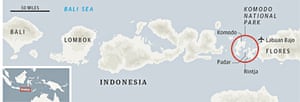
Intrepid divers, and dragon chasers, have been coming to Komodo since the 1980s, but it's only in the past few years that the islands' more mainstream pleasures have attracted attention. The number of foreign arrivals on Flores Island, gateway to the Komodo national park, topped 60,000 in 2013, up 20% on the year before.

Being named one of the New Seven Wonders of Nature in 2011, by conservation body the New7Wonders Foundation, no doubt helped. But this area also has colourful fishing villages, coral cays and deserted beaches of pale pink sand.

As well as the above, it's got dragons, world-class diving, ragged volcanic islands straight out of King Kong (the films were inspired by American millionaire W Douglas Burden's expedition here in 1932). Plus it has the kind of laidback vibe (and budget) that appeals to backpackers on the hunt for the next undiscovered destination – along the lines of Bali but 15 years ago. Flights to Flores from Bali cost about £85 return, and take an hour and a half. What's not to love?

"Three years ago, there was hardly any interest in Flores and Komodo – we were really lucky to get this place," Stefano says as, after a day's diving, we pull up to the wooden jetty on his private island, Sebayur Besar, between Komodo and the north-western end of Flores.

Undulating hills of russet grass descend to a dazzling white beach, with a fringing reef visible beneath the limpid water. It's here that, in April last year, Stefano opened the Komodo Resort Diving Club. Thatched beach bungalows perch on stilts along the shoreline and a cluster of curved bamboo pavilions serve as the restaurant, dive centre and lounge.

Over an excellent five-course dinner – authentic melt-in-the-mouth Italian gnocchi and spicy Indonesian-style fish – Stefano tells me he has spent the past 18 years leading expeditions into the remoter parts of Papua New Guinea. But, he muses, without a trace of irony: "I thought it was time to settle somewhere a bit less remote."

The diving club is 200m from the edge of the national park, which stretches several kilometres offshore around the islands of Komodo, Rintja and Padar. Land-based resorts aren't allowed inside it. More than 20 world-class dive sites are within easy reach of the resort, which is also an hour by speedboat from Labuan Bajo, the ramshackle harbour town on Flores where the airport is.

Stefano's is the third offshore resort to have sprung up on the park's borders over the past four years – luxury eco-resort Angel Island, about 3km from Labuan Bajo, opened in 2010, and backpacker favourite Kanawa Beach Bungalows, on the island of the same name a little further north, a year later.

 Komodo Resort PR

If Komodo Resort has the après-scuba down pat (think giant bean bags and iced drinks on the dive boat's snazzy sun deck), Kanawa Beach has…well, a beach. And the kind of island vibe you get by combining said stretch of sugary white sand with excellent snorkelling off the jetty, pared-down beach bungalows (there are tents for committed Robinson Crusoes) wood-fired pizzas, cold beer and reggae that sounds like it's being played on a blown guitar amp.

There I meet a French free-diving enthusiast who has been here for eight days "to unwind". It turns out she lives on Koh Tao, the serene palm-fringed island in Thailand.

It's hard not to succumb to a sort of tropical torpor in such idyllic surroundings. But I'm roused by the prospect of swimming with manta rays. Brit Ed Statham, whose swarthy complexion and random tattoos are testament to his commitment to the lifestyle, has opened an independent dive outfit on Kanawa, taking people to Manta Point, another legendary dive site which is also shallow enough to snorkel. When six shadowy shapes materialise out of the deep blue, I'm struck by their sheer size – their wingspans must be four or five metres. They oscillate gently to counter the current while tiny fish nibble the parasites off their skin.

And, of course, you have to see the world's largest living lizards. On Komodo Island a few years ago I had to hightail it out of the forest with five slavering dragons in hot pursuit after a park ranger deprived them of the goat they were hoping to devour. It had been hung from a tree as a lure and when it was pulled out of their reach they turned their reptilian gaze on me.

 Diving off Komodo PR

They've held a strange fascination ever since. I head to Rinca, an hour by boat from Labuan Bajo, where spindly lontar palms punctuate a savannah-like landscape. But we arrive late, and at midday they are doing pretty much what all lizards do when the sun is high – snoozing. So I head back to my hammock at Kanawa and follow suit.

Surfing and Relaxing in Nihiwatu Beach


Paradise with a conscience: Nihiwatu on Indonesia's Sumba island
By Andrew Demaria, CNN

resort with the community has led to various eco- and sustainability awards
"This has been voted one of the best left-hand breaks on the planet. But watch out for the reef if you get dumped -- try and shallow fall."

The surfing instructor knows who he's dealing with -- an uncoordinated, naturally ungifted sportsman on the wrong side of fit and very embarrassed at being Australian yet unable to surf.

And totally in awe of the view back to the beach and surrounding coastline while floating impressively ungainly between wave sets.

A scene like this, of the beach, gardens and hillside of the unassuming Nihiwatu resort on Indonesia's eastern island of Sumba island, makes a morning of shallow falling (read: tumbling like a drunken cat in a washing machine) totally palatable.

The beauty is immense and the urge to dole out "paradise"-riddled cliches is equally immense.

Yet, there's something more tranquil about this setting, a sense of harmony in the way the resort blends in effortlessly with its surroundings -- even with this surfer wannabe in the frame.

The hotel is the remarkable result of a vision of colorful resort founder Claude Graves, who in 1984 with his wife, Petra, packed up their life in Africa to go in search of the perfect wave.

The ambition, he says, was to create a "perfect place" around that perfect experience.

It has so far proven a story well worth retelling.

"I wanted to create something totally experiential that didn't detract from the area," says Grave. "The best travel is around the best experiences."

After four years, and finding what has become known locally as The Wave, he and Petra ended up here in Nihiwatu on the southern coast of the relatively unknown Sumba, an island about an hour's flight east of Bali.

The couple camped on the beach, an idyllic 2.5-kilometer-long stretch of sand.

The beach is still difficult to access for anyone other than local villagers, and thus serves as something of a private beach for guests.

It's hard to imagine this same sand was the scene, barely six months before the Graves' arrival, of a massive battle between 2,000 local tribesmen.

Indeed, Sumba could be easily labeled an island that time almost forgot.

That clash was an illustration of the fiercely traditional, territorial and tribal nature of Sumbanese culture -- reinforced by the swords the village men strap to their sides to this day.

It's also, by Western standards, incredibly poor with little to no utilities access and infrastructure for many, if not most, villages.

This lack of standard resources posed a challenge for Graves and his plans.

Becoming Sumbanese

Through years of assimilation, negotiation, trust and countless pig sacrifices, Graves ingrained himself with the local community.

"We always said that if we found and developed a place, it had to be inclusive," says Graves, who confesses to not being a "hotel man."

"Tourism has the best potential economically in Sumba but if locals are not connected to it, it will be a big disaster.

With more than 300 Sumbanese workers, the hotel is the largest employer on the island.
"We couldn't imagine building a hotel here without including the locals so that all would benefit."

Claude began building what became the only resort on the island -- training and employing locals from various tribes and encouraging inter-tribal marriages, to assist in easing tensions.

The hotel soft opened in 2001 and had its first full year in 2005.

Keen to protect the highly regarded surf spot from the overuse and abuse displayed in places like Bali, Graves restricted the number of surfers allowed at the hotel at any one time.

He eventually acquired around 600 acres but developed only a small portion of that, impacting as little of the environment as he count

The Sumba Foundation

Quickly, the location became something of a surf icon, attracting to this day those chasing that perfect wave. A natural reef provides a clean, rolling break.

It also drew Sean Downs, a U.S. businessman who was so taken by the location, the people of Sumba and their needs, that he established the Sumba Foundation with Graves in 2001.

The foundation now impacts and supports around 120 square miles around the hotel and has directly reduced malaria infection rates by 85% in the 400-plus villages in that area.

There are now five health clinics as well as malnutrition programs in the area, created from some of the approximate $5 million donated to the foundation so far.

The foundation supports several schools and has built more than 60 water wells and around 250 water stations.

The latter has been key in helping to empower communities, says Rudi Weru, the on-the-ground manager and part of a team of around three dozen full-time Sumba Foundation staff.

"Now people don't have to spend their whole day traveling to fetch water. Instead, children for instance can go to school and learn," Weru says.

The Sumba Foundation is independent financially from the hotel, but draws on donations from Nihiwatu guests, the wealthier of which account for a high percentage of donations and thus impact directly the tens of thousands of locals the foundation supports.

A young child is weighed at a malnutrion center. Almost half of 70 children registered at the center were found to be underweight.
"More and more these days people want to have a purpose with traveling. It's not enough where people go and lie down on the beach and have a drink," says Dr Claus Boch, the foundation's health program director.

"You can't just come and enjoy the beauty of the place without giving back. So I think it really works extremely well between the hotel, the foundation and what we do."

Due to its association with the foundation and integration with the environment and local communities and customs, the hotel has won a raft of responsible and sustainable tourism awards.

Graves hopes his model is transferable elsewhere.

"Places like this that are leading the way will influence older hotels and sections of the industry. Clients will demand it. People will say I am not going to that hotel and instead go to where they feel their money is being well spent," Graves says.

The hotel is the largest employer on the island with around 300 full-time Subanese staff plus 150 daily workers -- making up more than 90% of its total workforce.

Dato Daku is among the original employees.

For him the experience at Nihiwatu -- from a daily worker to gardener to restaurant waiter -- is easily summed up.

"I want to die here," the father of three boys and three girls told CNN during a visit to Sumba last year.

"In Sumba it is difficult to find a job. It has helped a lot of local people find work.

"I can send my brothers and sisters and children to university or other parts of Indonesia now."

More than surfing

The hotel has 22 exceptional open-plan villas, designed to be low impact, drawing on Graves' philosophy and vision of integration by utilizing local designs, materials and construction techniques.

Experiences for Nihiwatu guests can include trips to nearby villages and clinics or programs the Sumba Foundation runs or supports.

"You can go into the villages, you can experience daily life, you can go to the markets and you can contribute if you want. And most do because they want to and it's not a tough sell. They really want to be a part of it and they really want to keep coming back to see the good work they've done," says James McBride, managing partner at Nihiwatu.

The Wave remains the most famous draw card, luring surfers from the world over, and limits itself to 10 surfers at the break per day.

Another 10 villas are due to be completed by March 2015 -- part of a plan to host those keen on more than just surfing.

Indeed, for those like this writer, not able to ride a board, there's a lot more to Nihiwatu than surfing.

The range of activities available includes a full range of spa options, waterfall hikes, biking, scuba diving and snorkeling, yoga, day trips and horseback riding.

A stand up paddleboard trip to nearby Wanukaku river is thoroughly recommended, but be warned of smiling local kids who dive bomb paddlers at every opportunity.

The hotel has 22 villas with 10 more on the way.

Graves recently stepped back from his role at the hotel, selling it to new owner Chris Burch, who has partnered with shareholder and established hotel manager, McBride.

Graves is in and out of Sumba and still focused on the Foundation now that there are a regular batch of guests that keep returning -- many of them keen to see the continued progress their support for the foundation has made.

"We've proven that if you get it right, guests will come back. Guests get involved and it is beneficial for all," Graves says.

And this guest just might even be able to surf next time around.

How to get there

All profits from Nihiwatu go to the Sumba Foundation. You can make donations or find out more about the foundation here.

Rates are all inclusive (food, drinks, activities) with some optional extras.

Accommodation starts at $495 per person per night for the rest of 2014, based on double occupancy and are exclusive of VAT and service charges.

From March 2015, full board rates (food and non-alcoholic drinks) start at $900 per room per night based on the size of the villa. Activities are at an additional cost.

There's a minimum stay of three or seven days, depending on the season (high season runs mid-June to mid-October).

Nihiwatu is closed January and February.

There are three flights daily to Sumba's Tambolaka airport on the west of the island (plus a weekly charter flight) and the hotel will organize transfers.

Flight connections are made via Bali's Ngurah Rai International Airport in Denpasar.

Vacation to Indonesian

Come Vacation to Indonesia

Indonesia is a large country in Southeast Asia. A beautiful island nation sandwiched between Asia and Australia. Natural resources and tourism potentials in the country very much and will not be exhausted enjoyed.

Indonesia has 17,508 islands that line from east to west. 6,000 of which are uninhabited islands and has a beautiful natural scenery. A long coastline of the country is very long so much potential for coastal tourism and diving are very beautiful.

Tourism potential of all of this, Bali is the most famous in the world. Even some of the tourist sites call this area is the best place for a holiday. Almost no other place in the world that offers the charm of natural beauty and culture such as Bali.

Not only Bali, there are many other areas that have the same beauty and scattered in all parts of Indonesia. Examples Raja Ampat in Papua, Beach Gili Trawangan, Lombok, Beach Bunaken in North Sulawesi, and many other tourist locations.

Amazing Indonesian will review a wide range of the best tourist locations in Indonesian. We will roam the best places and introduce a tourist spot but has a hidden beauty like diamonds.

Let's Travel to Indonesia ...